Is the Planning Department in Cahoots with Developers
Updated: Feb 8
Why is the Planning Department so focused on having this development approved, whose side are they on? And why?
Most of us think the City should protect our interests - existing residents' interests - or at least balance us against the interests of wealthy developers. But does the city see it that way? Emails obtained by KSB through a public records demand show that no, it doesn't - the Planning Department focuses primarily on the interests of developers and disregards the interests of residents, even going so far as to change city policy and precedent to advance bad developments and to coordinate with developers to ensure approval of projects by the Planning Commission and City Council, even providing potentially misleading information to try to force the hand of the Planning Commission - without consideration of whether the projects are in the best interests of the city or its residents.
One example is the city's review of the highly controversial development at Watten Ponds. In a critical effort to advance the development at Watten Ponds, a development in a historically protected wooded wetland area, Planning Director Jake Griffiths, an unelected city bureaucrat, appears to have unilaterally changed city policy and overruled historical precedent to remove a rule that likely would derail the development.
Andrew Budde, the City Engineer, notified Mr. Griffiths that the Watten Ponds development would require wetland areas to be moved to separate properties, which would mean the wetlands would not count toward zoning requirements for issues like minimum lot size and and impervious surface restrictions. If the wetlands were removed as required under existing city law, the proposed development likely would have to be rejected or at least completely revised.

(Ed. note: "Marie" is the long-time Planning Director before Mr. Griffiths took the position in 2024).
In fact, the application of city law was not unclear or hypothetical - local residents informed KSB that city employees had repeatedly told them that this specific property could not be developed under city law. Mr. Budde's response letter to the developer required the wetlands to be placed in outlots.
However, this answer was apparently not the outcome that Mr. Griffiths desired, and he suggested to Mr. Budde that he planned to change the city's application of its own code and overrule long-time precedent.

Although the record is not clear, it appears Mr. Griffiths did exactly that. Mr. Griffiths and Mr. Budde appear to have discussed Mr. Griffith's desire to change city policy in order to assist this specific developer, as Mr. Budde responds with a revised recommendation letter that, he states, "will help them advance their design." Mr. Budde's revised letter removed the requirement for outlots. We are not aware that Mr. Griffiths informed the Planning Commission, City Council or anyone else of his unilateral decision to change how the city applies its rules in order to support this development. It is a government of one.

Editor's Note: the initial and revised versions of Mr. Budde's memo should have been provided in response to the Freedom of Information Act request but Mr. Griffiths only provided the second, revised memo - the one that helps advance the developer's design. He did not provide the original memo that requires the wetlands to be in outlots. Only after four FOIA requests, a City effort to withhold Mr. Budde's documents because he is technically an employee of a private firm that contracts with the City, and a FOIA request directly to Mr. Budde did the City finally disclose the first memo - just days before the City Council meeting to approve the development.
But Mr. Griffiths' efforts to help the developer did not stop there. Further emails show Mr. Griffiths strategizing with and making suggestions to the Watten Ponds developer on how to overcome residents' objections at the Planning Commission meeting in order to help ensure that the project was approved, regardless of residents' concerns. Mr. Griffith's help was not unnoticed - the emails end with the developer thanking and praising Mr. Griffiths for his "great job" and "help".
The thread starts with Mr. Griffiths, on his own initiative, taking it upon himself to reach out to Tom Goodrum, the developer's consultant tasked with pushing the city approvals, to warn him to expect resident opposition at the Planning Commission meeting.

Mr. Goodrum was of course appreciative of the warning and responded with gratitude and a request for further information:

Mr. Griffiths provides additional details on the residents' concerns and then goes so far as to coach Mr. Goodrum on how to respond to residents so as to most successfully ensure approval of the project:

At the meeting, Mr. Goodrum and Audrius Asakenas, the developer of the project, did in fact respond as coached by Mr. Griffiths.
Mr. Griffiths also met with residents about the development, but Mr. Griffith did not provide residents with any coaching or advice on how to respond to the project based on their interests. That support apparently is reserved for developers, not residents. To the contrary, Mr. Griffiths informed the residents that he believed the project would meet the minimum requirements of the code and would be approved, but did not inform residents that such approval likely required his change to city policy.
At the Planning Commission meeting, many residents informed KSB that they believed that Mr. Griffiths went out of his way to support the development and push the Planning Commission to approve it, even going so far as to provide responses that were, if not untrue, quite arguably misleading. For example, the Planning Commission asked if the city could extend the 120 day deadline for approving the application. Mr. Griffiths responded that the city could not extend the deadline. That answer appears to be both true and misleading. The city cannot unilaterally extend the deadline, but KSB has been informed that the city can ask the developer to extend, and if the developer refuses, the city can simply deny the application to cause the 120 day deadline to restart. The Planning Commission was inquiring if the city had any way to get more time and Mr. Griffith's response, while true to the limited question that he chose to answer, was not the answer to the question that the Planning Commission intended, and we believe was misleading in a way that was intended to force the Planning Commission to approve the project at the meeting rather than asking for more time.
Mr. Griffiths' policy change, developer-serving mischaracterization of city timelines and advocacy for the developer are only part of a larger approval process that we believe is inappropriate and biased toward pushing approval of the project for the developer. We discuss this in more detail in our post Bulldozing Residents and Trees. How many fingers does the Planning Department have on the scale in favor of the developer?
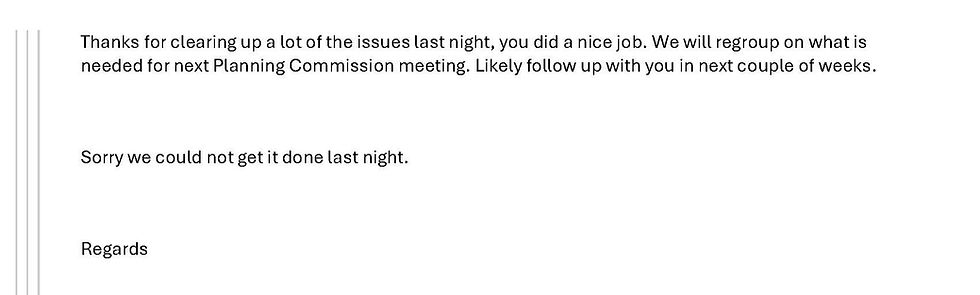
Not surprisingly, Mr. Asakenas, the developer, and Mr. Goodrum, his consultant, were thrilled with Mr. Griffith's performance in front of the Planning Commission, with Mr. Asakenas acknowledging his "great job" and expressing his gratitude for Mr. Griffiths' support.

Similarly, Mr. Goodrum thanked Mr. Griffiths for his "good job".
Mr. Goodrum also, very strangely, apologized to Mr. Griffiths, the city Planning Director, for not getting "it done last night." Why would a developer apologize to the Planning Director in response to the Planning Commission not approving the developer's project? Why would the Planning Director be upset or hurt by the Planning Commission's delay in approving the development? Or, what upside for Mr. Griffiths did he miss out on because the development was delayed?

Overall, we believe that these emails raise questions about the impartiality of the Planning Department and whether the Planning Department has not just its finger but it's whole fist on the scale in support of developers. Why is it that the city focuses on the interests and goals of developers and disregards the interests and goals of existing residents, who have invested vast amounts of time, effort and money to build neighborhoods?


Comments